
Tobacco and Infertility: What the Latest WHO Evidence Means for Couples meta keywords please
When couples think about fertility, attention often turns to age, ovarian reserve, sperm count, hormones, fallopian tubes or embryo quality. One important and potentially modifiable factor can receive less attention: tobacco exposure.
On 8 September 2026, the World Health Organization (WHO) published a new evidence summary, Tobacco and Infertility, reviewing current research on tobacco exposure and reproductive health.
The message is relevant to both women and men: tobacco use is associated with reproductive harm, and smoking history should form part of fertility assessment and preconception care. (World Health Organization)
What did WHO report?
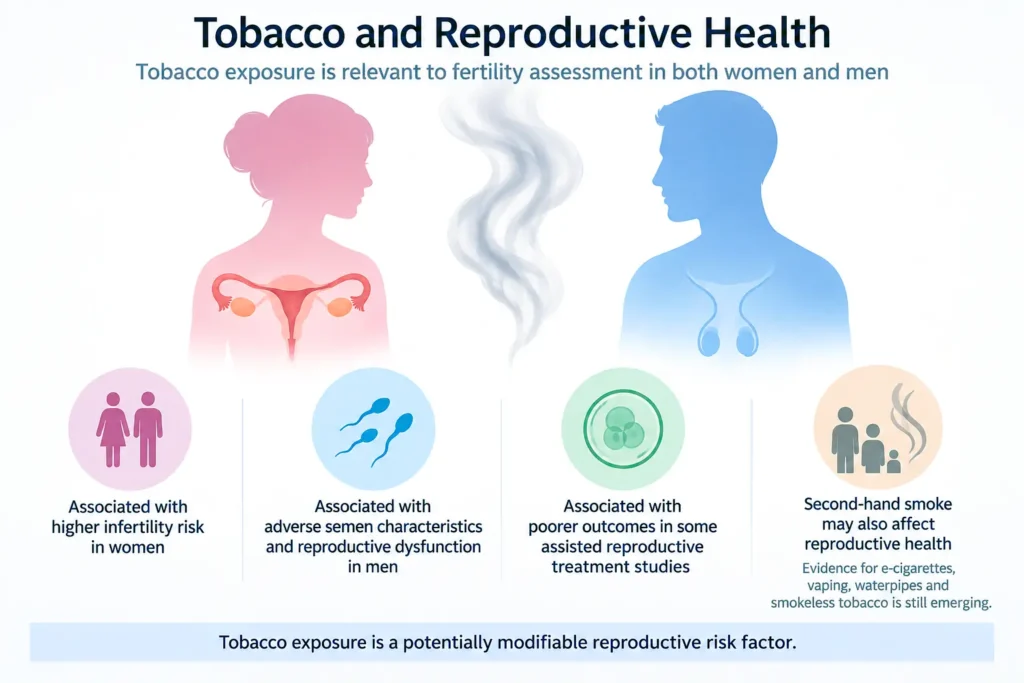
WHO highlighted four clinically important areas:
- Women who currently smoke have a higher observed risk of infertility.
- Smoking is associated with abnormalities of male reproductive and sexual function.
- Cigarette smoking may adversely affect outcomes of assisted reproductive treatment.
- Second-hand tobacco smoke may also affect reproductive health.
Importantly, evidence concerning e-cigarettes, vaping, waterpipes and smokeless tobacco is less mature than the evidence for conventional cigarette smoking. Their effects on fertility should therefore not be assumed to be harmless simply because long-term reproductive data remain incomplete. (World Health Organization)
1. Smoking and female fertility: approximately 40% higher infertility risk
One of the most striking findings highlighted by WHO comes from a systematic review of studies published between 2000 and 2026.
Women who currently smoked tobacco had approximately a 40% higher risk of infertility than women who did not smoke. (World Health Organization)
This figure requires careful interpretation.
A 40% increase is a relative increase in risk. It does not mean that 40% of women who smoke will become infertile, nor does it establish that smoking caused infertility in every affected individual.
Fertility is influenced by many interacting factors, including:
- female and male age;
- ovarian reserve and ovulatory function;
- tubal and uterine factors;
- endometriosis;
- sperm quantity and quality;
- metabolic and general health;
- frequency and timing of intercourse; and
- environmental and lifestyle exposures.
Nevertheless, tobacco exposure is particularly important because, unlike age or many underlying diagnoses, it is potentially modifiable.
Does stopping smoking matter?
Encouragingly, WHO reports that women who had smoked previously but were no longer current smokers showed a 25% lower infertility risk compared with women who continued smoking in the evidence reviewed.
This observational finding should not be interpreted as a guarantee that fertility will recover after stopping smoking. However, it strengthens the rationale for incorporating tobacco cessation into preconception and fertility care. (World Health Organization)
2. Tobacco is also a male fertility issue
Infertility should never be approached solely as a woman’s problem.
WHO highlighted a review of 44 studies involving more than 60,000 men, in which smoking was associated with reproductive dysfunction, including semen abnormalities and sexual dysfunction.
Reported associations included problems involving:
- sperm concentration and count;
- sperm motility;
- sperm morphology;
- azoospermia in some populations;
- erectile dysfunction; and
- ejaculatory dysfunction. (World Health Organization)
Previous systematic-review evidence has similarly demonstrated adverse associations between cigarette smoking and conventional semen parameters, with more pronounced effects reported among moderate and heavy smokers. (PubMed Central (PMC))
Beyond the routine semen analysis
A standard semen analysis measures concentration, motility and morphology, but male reproductive biology extends beyond these conventional parameters.
Cigarette smoke contains numerous chemicals capable of promoting oxidative stress and cellular injury. Research has therefore investigated effects extending to sperm functional and molecular characteristics.
However, the magnitude and clinical significance of these effects vary between studies. A normal semen analysis should consequently not be interpreted as evidence that tobacco exposure is biologically irrelevant, while an abnormal semen analysis in a smoker should not automatically be attributed to smoking alone.
3. Smoking and IVF: why tobacco history matters before ART
For couples undergoing IVF or ICSI, tobacco exposure remains clinically relevant.
WHO cites an earlier synthesis of 21 studies in which cigarette smoking was associated with fewer pregnancies and live births following assisted reproduction. The findings suggested that successful ART outcomes could be substantially reduced among smokers in the populations studied. (World Health Organization)
Other large observational ART data have found increased odds of treatment-cycle cancellation among smokers, although not every reproductive outcome showed a statistically significant difference. (PubMed Central (PMC))
This distinction matters.
Smoking should be regarded as a reproductive risk factor—not as a deterministic predictor of IVF failure.
IVF outcomes depend on multiple factors, particularly age, ovarian reserve, sperm characteristics, embryo competence, reproductive diagnosis and treatment-related variables.
Therefore, tobacco cessation should form part of preconception health optimization, rather than being presented as a promise of improved IVF success.4. Second-hand smoke matters too
A person does not necessarily have to smoke personally to experience tobacco exposure.
WHO reports evidence suggesting that women exposed to second-hand tobacco smoke may have an increased risk of infertility and a reduced probability of conception during each menstrual cycle. (World Health Organization)
For couples trying to conceive, the practical implication extends beyond asking:
“Do you smoke?”
A more complete fertility history should consider:
“Does either partner use tobacco, and is either partner regularly exposed to tobacco smoke at home, work or socially?”
Creating a smoke-free home environment is therefore relevant to reproductive as well as general health.
5. What about vaping and e-cigarettes?
This is an important area of uncertainty.
The evidence linking conventional cigarette smoking with reproductive harm is considerably more established. In contrast, WHO describes evidence concerning e-cigarettes, waterpipes and smokeless tobacco as still emerging. (World Health Organization)
That uncertainty should not be translated into reassurance.
Electronic nicotine-delivery systems can expose users to nicotine and other chemicals, but long-term human fertility studies have not yet reached the depth available for cigarette smoking.
For someone planning pregnancy or fertility treatment, switching from cigarettes to vaping should therefore not automatically be considered a proven fertility-protective strategy.
6. Tobacco assessment should involve both partners
One of the most useful implications of the WHO report is simple:
Fertility optimization is a couple-based process. Tobacco assessment should be too.
During infertility or preconception evaluation, clinicians should routinely establish:
- current cigarette or other tobacco use;
- previous tobacco use;
- frequency and duration of exposure;
- use of vaping or other nicotine products;
- second-hand smoke exposure; and
- willingness and readiness to stop tobacco use.
WHO recommends that healthcare professionals discuss the reproductive risks of tobacco with people planning pregnancy and provide evidence-based cessation support to tobacco users. (World Health Organization)
The broader 2025 WHO infertility guideline similarly identifies tobacco as an important preventable infertility risk factor and recommends lifestyle measures, including tobacco cessation, for individuals and couples planning or attempting pregnancy. (World Health Organization)
What should couples planning pregnancy do?
If either partner smokes, the objective should be cessation rather than simply reducing exposure whenever feasible, supported by an appropriate healthcare professional.
Couples can consider four practical steps:
- Tell your fertility team about all tobacco and nicotine exposure, including cigarettes, smokeless tobacco, vaping and passive smoke.
- Make the home smoke-free and reduce avoidable second-hand exposure.
- Seek structured cessation support rather than relying only on willpower or repeated informal advice.
- Discuss cessation early, ideally during preconception planning rather than waiting until pregnancy or IVF treatment has already started.
WHO emphasizes that brief cessation advice should be provided consistently to tobacco users across healthcare settings. (World Health Organization)
The Krishna IVF perspective
At Krishna IVF, fertility evaluation is approached as an assessment of both partners.
Lifestyle and environmental exposures should be considered alongside reproductive age, ovarian reserve, ovulation, uterine and tubal factors, semen characteristics, medical conditions and other clinically relevant factors.
The objective is not to blame patients for infertility.
Rather, identifying modifiable exposures gives couples an opportunity to improve their overall reproductive and preconception health while appropriate investigation and treatment continue.
The current evidence supports a clear clinical principle:
Tobacco exposure should be treated as a modifiable reproductive risk factor in both partners—not simply as a women’s health issue.
Stopping tobacco cannot guarantee natural conception or IVF success. But avoiding tobacco is an evidence-based component of healthier preconception care and has substantial health benefits extending far beyond fertility.
Key takeaways
Smoking and female fertility: WHO reports approximately 40% higher infertility risk among current female smokers compared with non-smokers in a recent systematic review.
Smoking and male fertility: Evidence links smoking with adverse semen characteristics and male sexual/reproductive dysfunction.
IVF and ICSI: Smoking has been associated with poorer ART outcomes in several studies, although effect estimates vary and individual outcomes are multifactorial.
Second-hand smoke: Passive exposure may also adversely affect fertility.
Vaping and newer products: Evidence is still developing; absence of mature evidence should not be interpreted as proof of reproductive safety.
Clinical action: Ask about tobacco exposure in both partners and integrate evidence-based cessation support into preconception and fertility care.
References
- World Health Organization. Tobacco and infertility. WHO Tobacco Knowledge Summaries. Geneva: World Health Organization; 2026. Published September 8, 2026. (World Health Organization)
- World Health Organization. Tobacco smoking may be harming your chances of having a baby. Geneva: WHO; September 8, 2026. (World Health Organization)
- World Health Organization. Guideline for the prevention, diagnosis and treatment of infertility. Geneva: WHO; 2025. (World Health Organization)
- World Health Organization. Tobacco and nicotine. Updated June 26, 2026. (World Health Organization)
- Barratt CLR, et al. The diagnosis of male infertility: an analysis of the evidence to support the development of global WHO guidance—challenges and future research opportunities. Hum Reprod Open. 2017;2017(3):hox021. (PubMed Central (PMC))
Medical disclaimer: This article is intended for general education and should not be interpreted as individualized medical advice, diagnosis or treatment. Fertility and ART outcomes depend on multiple biological and clinical factors. People trying to conceive should discuss tobacco or nicotine use and appropriate cessation strategies with a qualified healthcare professional.