
Karyotyping in Infertility: What It Can Reveal
When a couple experiences infertility, repeated pregnancy loss, severe male-factor infertility, or repeated difficulty with embryo implantation, the cause is not always visible on an ultrasound, hormone test, or semen analysis.
Sometimes, an important clue is hidden inside the chromosomes.
A karyotype is a laboratory examination of a person’s chromosomes – the packages of DNA present in nearly every cell. It allows specialists to look at their number and large-scale structure. In selected fertility patients, this relatively established genetic test can uncover a chromosomal explanation that changes counselling, reproductive planning, and occasionally the type of genetic testing considered during IVF.
Think of it as chromosomal detective work.What exactly is a karyotype?
Humans usually have 46 chromosomes arranged in 23 pairs:
- 22 pairs of autosomes
- 1 pair of sex chromosomes – typically XX or XY
Karyotyping usually involves collecting a blood sample, growing cells in the laboratory, arresting them when the chromosomes are visible, staining them and examining their characteristic banding pattern.
The laboratory asks two fundamental questions:
Are all the expected chromosomes present?
Is there a major structural rearrangement of chromosome material?
This makes karyotyping particularly useful for detecting abnormalities involving whole chromosomes or relatively large chromosome segments.
The first clue: an extra or missing chromosome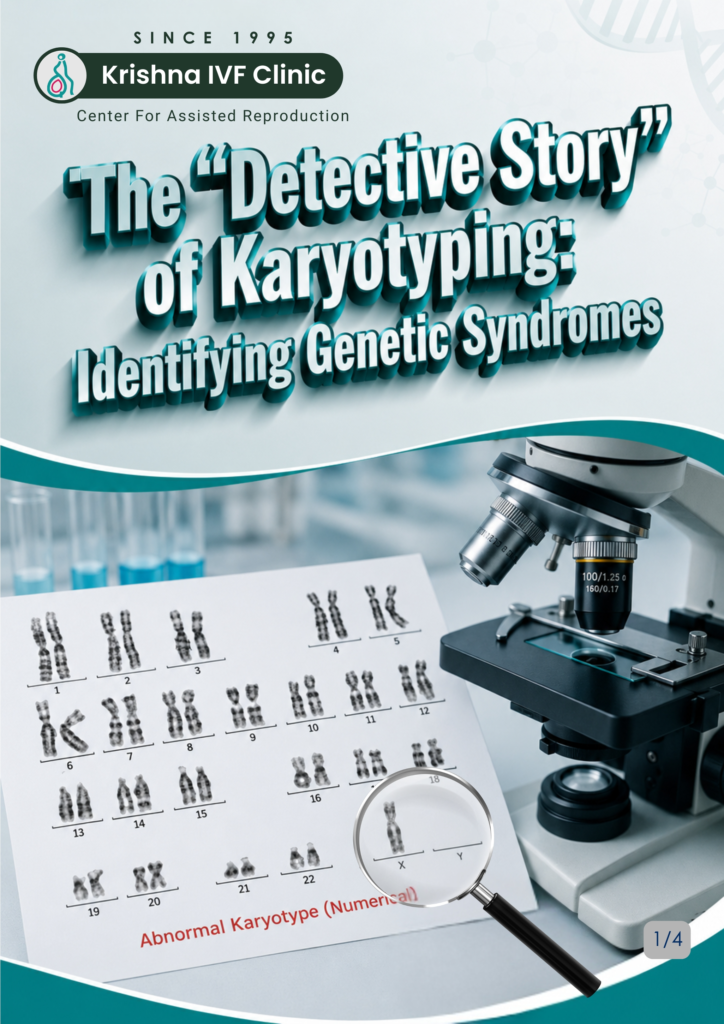
One fertility-relevant example is Klinefelter syndrome, most commonly represented by a 47,XXY karyotype. It can be associated with markedly impaired sperm production or azoospermia.
Current AUA/ASRM guidance recommends karyotype testing in men with primary infertility who have azoospermia or a sperm concentration below 5 million/mL when accompanied by evidence such as elevated FSH, testicular atrophy, or impaired sperm production.
Importantly, identifying a chromosome abnormality does not by itself tell us that biological parenthood is impossible. The finding needs to be interpreted alongside semen parameters, endocrine assessment, clinical examination and, where appropriate, reproductive-urology and genetic evaluation. The second clue: all 46 chromosomes are present – but arranged differently
This is where karyotyping becomes particularly interesting.
A person can have the correct overall amount of genetic material but carry a balanced structural chromosome rearrangement.
For example, pieces of two chromosomes may exchange positions. This is called a balanced reciprocal translocation. Another important category is a Robertsonian translocation.
Because little or no important genetic material may have been lost or gained, the carrier can be completely healthy and may never have suspected anything unusual.
The problem can emerge during reproduction.
When eggs or sperm are formed, the rearranged chromosomes must separate. Some resulting gametes may contain an unbalanced amount of chromosome material.
Depending on the particular rearrangement, this can contribute to infertility, miscarriage or conception of a pregnancy with an unbalanced chromosome complement.
The chromosome result therefore needs individualized genetic counselling rather than being interpreted simply as “normal” or “abnormal.”
Recurrent miscarriage: should every couple automatically have a karyotype?
This area has evolved considerably.
Chromosomal abnormalities are a major cause of early miscarriage. The 2026 ASRM Committee Opinion estimates that approximately 50-60% of first-trimester miscarriages are caused by embryonic aneuploidy, with the frequency strongly influenced by maternal age.
Modern evaluation therefore increasingly begins by asking:
What was the chromosome status of the pregnancy that miscarried?
ASRM recommends offering chromosome analysis of miscarriage tissue, when feasible, as part of recurrent pregnancy-loss evaluation and favors array-based methods because of several technical advantages over conventional cytogenetics.
Parental blood karyotyping then becomes particularly relevant when miscarriage testing identifies an unbalanced structural rearrangement, or when chromosomal testing of the miscarriages has not been available. ESHRE similarly supports a more individualized, risk-based approach rather than indiscriminate parental testing.
This is an important example of how reproductive genetics is moving from “order every test” toward “ask the right genetic question first.”
What happens when karyotyping finds a structural rearrangement?
The result is the beginning of the investigation – not the end.
The couple should generally receive genetic counselling to understand:
- What chromosome change is present?
A balanced reciprocal translocation, Robertsonian translocation, inversion, mosaicism or another finding can have very different reproductive implications. - Which partner carries it?
Reproductive risks can differ according to the chromosomes involved and whether the carrier is male or female. - What happened in previous pregnancies?
Miscarriage-tissue genetic results can be extremely informative. - What are the reproductive options?
Depending on the specific diagnosis, these may include natural conception with appropriate prenatal diagnostic options, IVF with relevant genetic testing, or other individualized pathways.
For couples undertaking IVF because of a known structural chromosome rearrangement, PGT-SR – preimplantation genetic testing for structural rearrangements – may be discussed. ASRM emphasizes that counselling should include the limitations of IVF/PGT-SR as well as alternative reproductive options.
PGT-SR should therefore never be presented as an automatic consequence of an abnormal karyotype or as a guarantee of pregnancy.
Karyotype, PGT-A and PGT-SR are not the same test
This distinction is particularly important for patients.
| Test | Principal question |
|---|---|
| Parental karyotype | Does either parent have a major numerical or structural chromosome abnormality? |
| Genetic analysis of miscarriage tissue | Was the pregnancy chromosomally abnormal, and could that explain the miscarriage? |
| PGT-SR | In IVF embryos from a family with a known structural rearrangement, which embryos have relevant unbalanced chromosome abnormalities? |
| PGT-A | Does the sampled embryo show chromosome copy-number abnormalities within the limitations of the testing platform? |
Finding a balanced translocation in a parent therefore does not simply mean that the couple “needs PGT-A.” The genetic question determines the appropriate test.
Why doesn’t everyone undergoing IVF need a karyotype?
Because good genetic medicine is indication-driven.
Karyotyping has important limitations. It cannot detect every disease-causing DNA variant, and many infertility disorders occur despite an apparently normal karyotype. Smaller copy-number changes or single-gene disorders may require other technologies such as chromosomal microarray, targeted molecular testing, gene panels, exome sequencing or other genomic approaches, depending on the clinical question.
Likewise, a normal karyotype does not mean that every genetic cause of infertility has been excluded.
The correct investigation depends on the phenotype, reproductive history and family history.
From microscope to genomic medicine
Conventional karyotyping remains valuable precisely because it answers a particular question extremely well: is there a major abnormality in chromosome number or structure?
But reproductive genetics is rapidly becoming more sophisticated.
Array-based chromosome analysis, next-generation sequencing and other molecular techniques can identify abnormalities that conventional chromosome microscopy may miss. ASRM notes that no single technology detects every possible genetic abnormality.
The future is therefore unlikely to be karyotyping versus genomics.
It is more likely to be karyotyping plus appropriately selected molecular genetics, with each investigation used for the question it is best designed to answer.
The Krishna IVF perspective
At Krishna IVF, reproductive genetics should be approached as part of an integrated clinical pathway involving reproductive medicine, embryology, genetics and appropriate counselling – not as an isolated laboratory report.
The most useful question is therefore not:
“Is my karyotype abnormal?”
but:
“What does this chromosome finding mean for us, and does it change our reproductive options?”
That distinction matters. Genetic testing should provide better information for decision-making, not create unnecessary anxiety or promise an outcome that medicine cannot guarantee.
When might you discuss karyotyping with a fertility specialist?
It may be considered particularly when there is severe impairment of sperm production or azoospermia, recurrent pregnancy loss, a chromosome abnormality detected in pregnancy tissue, recurrent implantation failure in selected circumstances, a relevant family history, or another clinical finding suggesting a chromosomal disorder. The indication should be individualized.
Educational note: This article provides general information and is not a substitute for individualized genetic counselling or medical advice. The significance of a chromosome finding depends on the exact abnormality, reproductive history, age and other clinical factors.
References
- Practice Committee of the American Society for Reproductive Medicine. Recurrent pregnancy loss: a committee opinion. Fertil Steril. 2026;125:1023-1041. ASRM
- European Society of Human Reproduction and Embryology. Guideline on the management of recurrent pregnancy loss. Update 2023. ESHRE
- American Urological Association; American Society for Reproductive Medicine. Diagnosis and Treatment of Infertility in Men: AUA/ASRM Guideline. 2020; amended 2024. American Urological Association
- Practice Committee of the American Society for Reproductive Medicine. Recurrent implantation failure: a committee opinion. 2026. ASRM