
World IVF Day 2026: What Patients Should Know Before Choosing Fertility Treatment
Six considerations to support an informed decision
By Prof. Dr. G.A. Rama Raju
July 25 is World IVF Day, marking the birth of Louise Brown in 1978, the world’s first baby born through in vitro fertilisation. Since then, IVF has helped millions of families. Globally, approximately one in six people of reproductive age experience infertility during their lifetime, a condition involving male-related, female-related, combined or unexplained factors that deserves appropriate medical evaluation. These six considerations may support informed care decisions.
1. Understand what infertility is
Infertility is generally defined as failure to achieve pregnancy after 12 months or more of regular, unprotected intercourse. Earlier evaluation is recommended after six months when the female partner is aged 35 or older, and without delay when a known condition affecting fertility is present.
Fertility difficulties may involve factors relating to the male partner, the female partner, a combination of both, or factors that remain unexplained after evaluation. A thorough assessment of both partners is an important starting point when treatment recommendations are being considered.
2. Seek evaluation at the right time
Age influences the ability to conceive in both men and women, though its effect is more pronounced in women. Egg number and quality decline progressively with age, becoming clinically more significant during the mid-to-late thirties, which may affect the likelihood of conception and the suitability of different treatment options.
Timely evaluation can identify contributing factors and clarify whether treatment is needed. It does not commit a patient to IVF or any other procedure. Fertility tests provide information about specific clinical factors; they should not be interpreted as a precise prediction of whether or when pregnancy will occur.
3. Treatment should be proportionate to evaluation findings
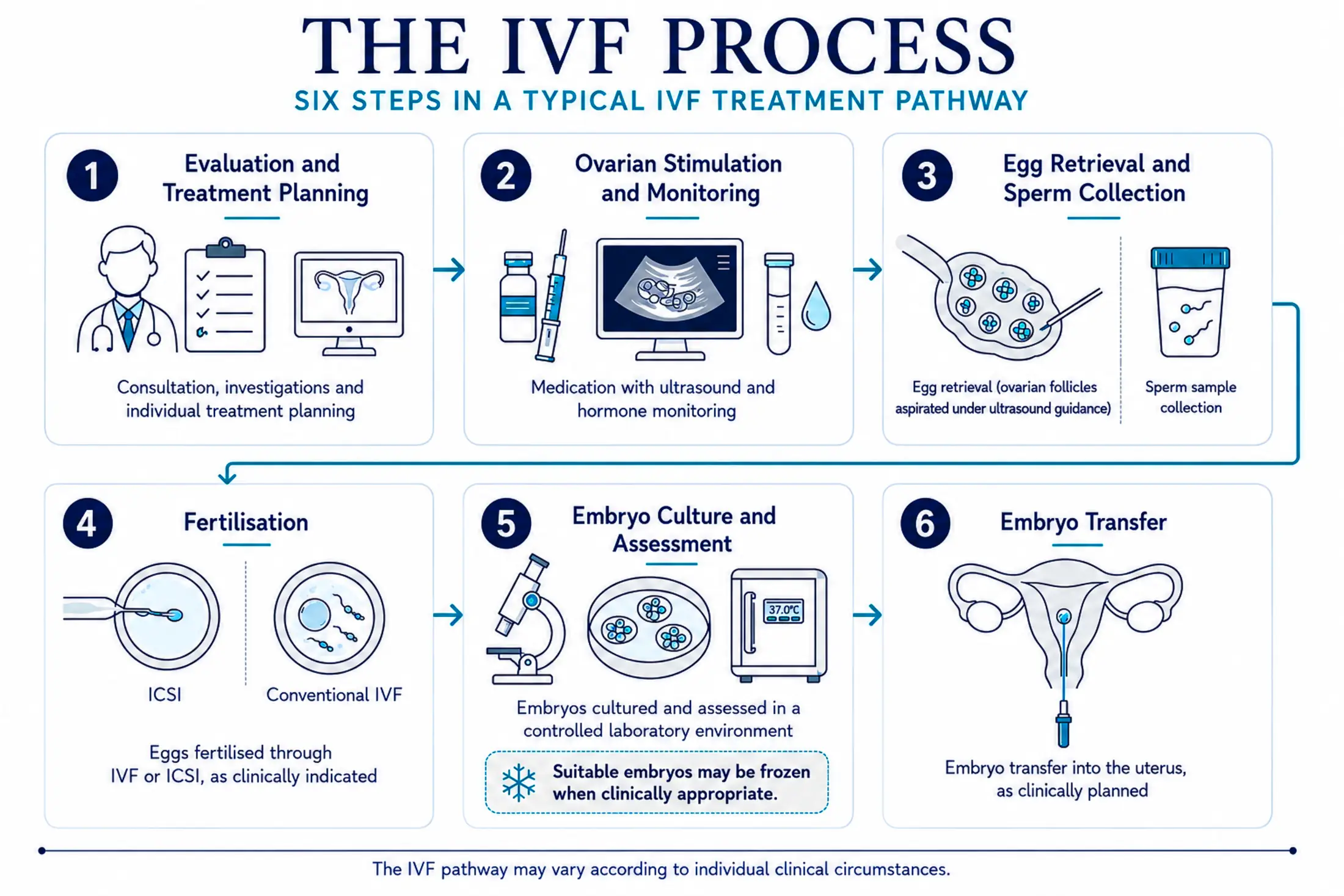
IVF is one of several assisted reproductive technologies. Treatment recommendations should reflect the evaluation findings. For some patients, less complex interventions may be appropriate first; for others, the findings may support proceeding directly to IVF.
The doctor should explain how the recommendation relates to your specific clinical findings. Patients may also ask whether further assessment is required and what the alternatives are.
4. The embryology laboratory is an essential part of IVF care
The work performed in the embryology laboratory, including fertilisation, embryo development and, when required, embryo freezing, is an essential component of IVF care. Laboratory conditions are one factor influencing treatment performance, alongside age, diagnosis, egg and sperm quality, embryo development and the condition of the uterus.
Patients may ask whether the laboratory follows documented internal quality-control procedures and participates in an external quality-assessment programme, one where an independent body evaluates specified parameters across laboratories. External quality assessment is different from internal quality control and should not be confused with formal accreditation of the laboratory.
5. Look for qualified professionals and evidence-based communication
Patients may ask about the qualifications and roles of the professionals involved in their care, including fertility specialists and embryologists. The treating team should be able to explain how its recommendations relate to current medical evidence and to your evaluation findings.
Peer-reviewed research makes aspects of a clinician’s work available for external examination. Citations indicate wider scientific engagement but do not directly measure clinical quality or expected treatment outcomes.
6. Consider the quality of patient education
Useful patient education should be consistent, accessible and clear about both the possibilities and limitations of treatment. Before choosing a fertility centre, examine its educational resources. Does the information explain procedures and limitations clearly? Does it avoid creating urgency or unrealistic expectations? Educational material should support, not replace, a consultation with a qualified professional.
Questions to carry into your consultation
Ask what will be investigated and why. Ask what the recommended treatment is based on and what the alternatives are. Ask about the laboratory’s external assessment. Ask what realistic outcomes look like for your specific profile.
Understanding IVF Outcomes and Expectations
IVF outcomes depend on age, ovarian reserve, egg quality, sperm-related factors, uterine factors, embryo development and other biological variables. They cannot be guaranteed by any clinic. Patients should expect appropriate evaluation, honest communication, realistic information and treatment recommendations based on their clinical findings.
At the heart of fertility care is the hope of having and raising a child. That hope deserves thorough, honest and science-based care.