
Comprehensive Clinical Analysis of Neurodevelopmental Outcomes and Reproductive Innovations: A 2026 Perspective for World Autism Awareness Day at Krishna IVF Clinic
The field of reproductive medicine has undergone a transformative evolution since the late 20th century, shifting from a singular focus on achieving pregnancy to a holistic commitment toward long-term offspring health and neurodevelopmental integrity. As the global community prepares to observe World Autism Awareness Day on April 2, 2026, the clinical discourse increasingly intersects with the principles of neurodiversity, ethics, and advanced biotechnology. Krishna IVF Clinic, established in 1996 in Visakhapatnam, stands as a testament to this evolution, having pioneered assisted reproductive technology (ART) in Coastal Andhra Pradesh while consistently integrating cutting-edge genetic research and evidence-based patient education into its core mission.
The Historical and Technological Foundation of Krishna IVF Clinic
The trajectory of Krishna IVF Clinic mirrors the broader advancements in Asian reproductive medicine. Under the leadership of Dr. G.A. Rama Raju, a senior infertility specialist with over 30 years of experience, the clinic achieved several landmark milestones, including the birth of Coastal Andhra’s first IVF baby on November 1, 1997, and the first baby born through Intracytoplasmic Sperm Injection (ICSI) in the region in 1998. These successes were not merely procedural but represented a shift toward addressing complex male and female infertility through precision medicine.
Technological Milestones and Clinical Infrastructure
The clinic’s commitment to precision is evidenced by its infrastructure, which includes the integration of advanced microscopy and metabolic monitoring systems. For instance, the use of Polscope—an advanced microscope for oocyte spindle viewing—allows for the non-invasive assessment of the meiotic spindle before sperm injection. This technique is crucial for protecting the genetic integrity of the egg, as improper spindle placement can lead to aneuploidy, a known risk factor for various developmental disorders.
Furthermore, the implementation of Geri technology—an innovative incubator featuring time-lapse monitoring—permits the evaluation of embryo morphology and developmental kinetics without removing the embryo from optimal incubation conditions. This continuous observation ensures that only embryos exhibiting the most stable developmental markers are selected for transfer, potentially mitigating risks associated with early-stage developmental stress.
| Technology | Clinical Application | Impact on Developmental Integrity |
|---|---|---|
| Polscope | Meiotic Spindle View | Assesses egg maturity and spindle location to prevent chromosomal errors during ICSI. |
| Geri Incubator | Time-Lapse Embryo Selection | Minimizes environmental stress and tracks kinetic milestones for optimal embryo choice. |
| ICSI | Direct Sperm Injection | Overcomes severe male factor infertility by selecting healthy individual sperm. |
| VIDAS | Automated Immunoassay | Provides high-quality hormone assays and blood tests through ELFA technology. |
| Integrated Genetics | Cytogenetics & Molecular Diagnostics | First center in Andhra/Telangana to offer comprehensive genetic screening since 2005. |
The facility also emphasizes a healing environment, recognizing that the emotional stress of the fertility journey can influence physiological outcomes. By combining nature-inspired clinic design with rapid diagnostic workups – such as the unique “One-and-a-Half-Day Work-Up” – the clinic aims to reduce patient anxiety and provide immediate clarity on reproductive potential.
World Autism Awareness Day 2026: The Paradigm of Humanity and Value
The 2026 observance of World Autism Awareness Day (WAAD) is characterized by the United Nations theme, “Autism and Humanity – Every Life Has Value”. This theme represents a culmination of decades of advocacy, moving beyond the simple “awareness” established in 2007 toward a framework of total inclusion and the recognition of neurodiversity as a vital component of human diversity.
The Evolution of Advocacy and UN Mandates
The origins of WAAD are rooted in UN General Assembly resolution (A/RES/62/139), proposed by Her Highness Sheikha Moza bint Nasser Al-Missned of Qatar and adopted unanimously in late 2007. The resolution sought to highlight autism as a growing global health priority. Over the subsequent two decades, the focus has shifted significantly:
1. From Awareness to Acceptance: Early campaigns focused on making the public aware of the symptoms of autism. Current initiatives emphasize accepting autistic behaviors and accommodating different ways of processing information.
2. The Neurodiversity Movement: This perspective reframes autism not as a “deficit” or a condition to be “fixed,” but as a natural variation in human cognition with its own set of strengths, such as pattern recognition and deep focus.
3. Human Rights and Agency: The 2026 message from UN Secretary-General António Guterres emphasizes self-determination, asserting that autistic people must have the opportunity to shape their own lives and participate in shaping the global future through fair employment and education.
Etiology and Pathophysiology of Autism Spectrum Disorder
Autism Spectrum Disorder (ASD) is a complex neurodevelopmental condition characterized by persistent challenges in social communication and interaction, alongside restricted, repetitive patterns of behavior or interests. Understanding its etiology requires a multi-layered analysis of genetics, epigenetics, and environmental exposures during the critical windows of prenatal development.
The Genetic Architecture of ASD
Current scientific consensus identifies ASD as a highly heritable condition, yet it is rarely caused by a single genetic mutation. Instead, it is typically polygenic, involving hundreds of common and rare variants that influence brain connectivity and synaptic function. While identical twin studies suggest a strong genetic basis, environment accounts for approximately 55% of the variance in risk, highlighting the importance of the prenatal and perinatal milieu.
In specific instances, however, ASD is linked to known monogenic conditions or chromosomal anomalies. These include:
● Fragile X Syndrome: The most common inherited cause of intellectual disability and a significant genetic link to autism.
● Tuberous Sclerosis Complex: A genetic disorder characterized by the growth of non-cancerous tumors, often presenting with autistic traits.
● Aneuploidy: Chromosomal imbalances, such as Trisomy 21 (Down syndrome), which may co-occur with ASD or similar developmental challenges.
Epigenetics and Environmental Stressors
Beyond the DNA sequence itself, epigenetics – chemical modifications like DNA methylation that regulate gene expression—plays a pivotal role in neurodevelopment. Research suggests that Assisted Reproductive Technology (ART) could potentially subject gametes and embryos to environmental stress, leading to epigenetic modifications. While evidence regarding a direct link between ART and ASD remains inconclusive, the study of “imprinting disorders” and DNA methylation patterns continues to be a central focus of research in reproductive biology.
Environmental risk factors during the prenatal period that have been associated with increased ASD risk include:
● Air Pollution: Exposure to particulate matter and heavy metals during pregnancy.
● Maternal Health Conditions: Type 2 diabetes, obesity, and hypertension have been shown in Krishna IVF’s own research to impact sperm DNA integrity and, by extension, potentially influence embryo development.
● Parental Age: Advanced maternal and paternal age is consistently identified as a primary contributor to neurodevelopmental risk.
Assessing the Association Between Assisted Reproductive Technology and Autism
One of the most persistent questions in reproductive medicine is whether children conceived through IVF and ICSI are at a higher risk for neurodevelopmental disorders. For years, the scientific community has debated this association, with conflicting results often stemming from variations in study design and diagnostic criteria.
Evidence from Population-Based Studies
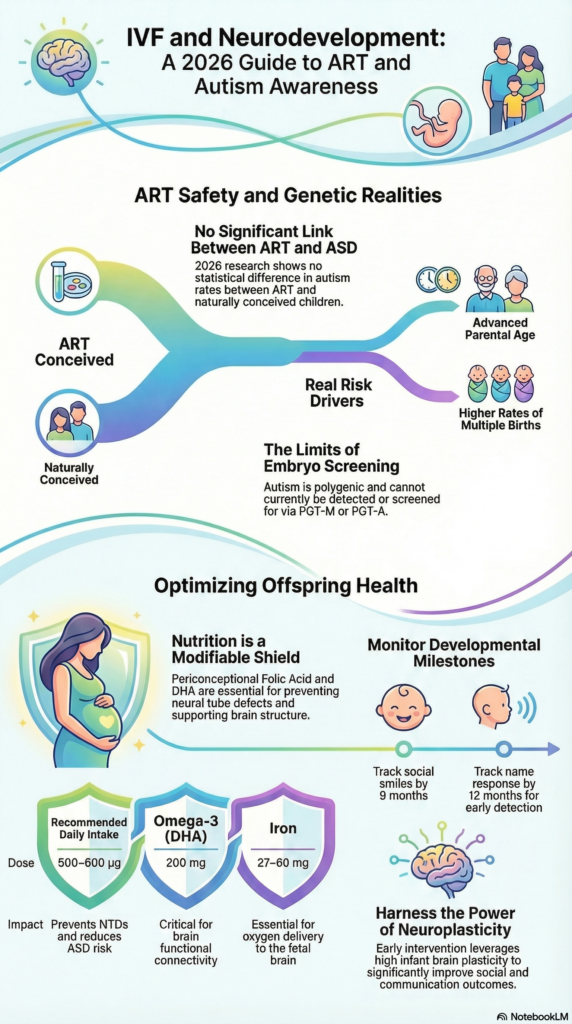
A landmark population-based study of over 5.9 million births in California provided critical insights into this relationship. While initial raw data suggested that the incidence of autism was twice as high in ART births compared to non-ART births, the association was significantly diminished when researchers adjusted for maternal age, multiple births, and adverse perinatal outcomes. This indicates that the procedure of IVF itself is likely not the cause, but rather the underlying factors associated with infertility—such as advanced age and the higher likelihood of twins or triplets—are the true drivers of risk.
2026 Case-Control Research Findings
In January 2026, a significant case-control study published in Journal of Child Neurology further refuted the association. The study compared 319 children diagnosed with ASD to 319 age-matched typically developing (TD) children. The findings were as follows:
| Parameter | ASD Group Rate | TD Group Rate | Adjusted Odds Ratio (aOR) |
|---|---|---|---|
| ART Usage | 8.5% | 9.4% | 0.537 (95% CI: 0.110–3.383) |
| Hormonal Treatment | N/A | N/A | 0.632 (95% CI: 0.326–1.223) |
| IVF Pregnancies | N/A | N/A | 0.689 (95% CI: 0.180–2.628) |
The statistical analysis showed no significant difference between the groups, providing strong reassurance that ART usage does not correlate with the presence or severity of autism. Furthermore, within the ASD group, the method of conception did not influence gender distribution or the clinical severity of the condition.
Meta-Analysis and Heterogeneity
While a 2026 meta-analysis indicated a potential relative risk (RR = 1.43) for ASD following ART, the authors noted high heterogeneity (I² = 87.9%) among studies. This suggests that the results are highly dependent on location, study quality, and clinical practices, emphasizing the need for high-quality, large-scale prospective studies in the future. For clinics like Krishna IVF, the primary takeaway is that current evidence does not justify changing health policies regarding the use of ART, but it does highlight the importance of minimizing multiple births and managing parental health prior to conception.
Preimplantation Genetic Testing: Capabilities and Ethical Limits
For many couples, the hope of modern fertility treatment lies in the ability to screen for genetic health before an embryo is transferred. Preimplantation Genetic Testing (PGT) has become a standard offering at Krishna IVF, but its application in the context of autism is limited by the condition’s biological complexity.
Understanding PGT Variants● PGT-A (Aneuploidy): Screens for an abnormal number of chromosomes. This is particularly beneficial for women of advanced reproductive age or those with a history of recurrent miscarriage. While PGT-A does not test for autism, it identifies embryos with the correct chromosomal count (46), which is fundamental for a healthy pregnancy.● PGT-M (Monogenic): Tests for specific, single-gene inherited disorders. If a family has a known mutation for a condition linked to autism, such as Fragile X syndrome, PGT-M can be used to select embryos that are unaffected by that specific mutation. ● PGT-SR (Structural Rearrangements): Identifies embryos with unbalanced chromosomal translocations or inversions, which can lead to significant developmental deficits. |
The “No Screening for Autism” Reality
It is critical to clarify that there is currently no validated clinical embryo test for autism as a standalone condition. Because ASD is polygenic and influenced by environmental factors, it cannot be traced to a single mutation that PGT-M could detect. IVF and PGT cannot identify “low-risk” embryos for autism or guarantee neurodevelopmental outcomes. At Krishna IVF, genetic counseling is provided to ensure families understand these distinctions, focusing instead on optimizing the health of the selected embryo through advanced selection techniques like hrNGS (high-resolution Next-Generation Sequencing).Prenatal Nutrition and Modifiable Risk Factors
As understanding of the fetal environment deepens, the focus has shifted toward modifiable factors that can mitigate neurodevelopmental risks. Research in 2025 and 2026 has increasingly highlighted the gut-microbiota-brain axis and its regulation by maternal diet.
The FSSAI and NIN Dietary Guidelines for 2026
The Food Safety and Standards Authority of India (FSSAI) and the National Institute of Nutrition (NIN) provide specific prenatal guidelines aimed at ensuring optimal fetal brain development and preventing low birth weight.
| Nutrient | Recommended Daily Intake | Primary Food Sources | Impact on Neurodevelopment |
|---|---|---|---|
| Folic Acid | 500–600 \mu g | Spinach, lentils, fortified atta, citrus. | Prevents neural tube defects (NTDs) and may reduce ASD risk when taken periconceptionally. |
| Iron | 27–60 mg | Beetroot, jaggery, rajma, lean meat. | Essential for oxygen delivery to the developing brain; |
| Omega-3 (DHA) | 200 mg | Flaxseeds, walnuts, small fatty fish (rohu). | Critical for brain structure and functional connectivity. |
| Calcium | 1000 mg | Ragi, curd, sesame seeds, milk. | Supports fetal skeleton and neuronal signaling. |
| Vitamin D | 400–600 IU | Sunlight (15 min/day), eggs, fortified dairy. | Modulates immune function and cellular growth in the brain. |
Managing the Fetal Environment
Mothers are advised to consume at least five food groups daily, including a variety of pulses, millets, and fresh vegetables. Conversely, high-sugar, high-salt, and high-fat (HFSS) foods should be strictly minimized, as they are linked to disruptions in the gut microbiota, which can negatively impact the fetal immune system and increase the susceptibility to ASD. Krishna IVF’s research has specifically noted the impact of lifestyle choices on reproductive outcomes. For instance, studies on type 2 diabetes and cigarette use have shown significant correlations with sperm DNA damage and reduced IVF success rates. By counseling both partners on nutrition and lifestyle, the clinic addresses the foundational elements of developmental health long before pregnancy is achieved.
Early Identification: Recognizing Milestones and Signs of ASD
Early intervention is the most powerful tool available for improving the quality of life for children on the autism spectrum. Because the infant brain possesses high levels of neuroplasticity, early therapeutic engagement can reshape neural pathways and enhance social and communication outcomes.
Developmental Milestones (0-36 Months)
While every child develops at their own pace, consistent delays in social and language milestones may indicate a need for professional evaluation.
● 9 Months: Should smile and laugh during interactive games like peek-a-boo; begins to babble.
● 12 Months: Uses simple gestures like pointing or waving; should respond to their own name.
● 18 Months: Should have at least three words besides “mama” or “dada”; points to show interest in objects.
● 24 Months: Notices when others are upset; begins to use two-word phrases.
● 36 Months: Engages in back-and-forth conversation; asks “who, what, where” questions; participates in imaginative play.
Early Red Flags for Autism
| Domain | Signs in Infants/Toddlers | Significance |
|---|---|---|
| Social Skills | Avoids eye contact; fails to respond to name; doesn’t share enjoyment. | Indicates challenges in joint attention and social reciprocity. |
| Communication | Unusual vocal tone (monotone/humming); loss of language skills; doesn’t use words by 15-18 months. | Suggests atypical development of language centers in the brain. |
| Behaviour | Repetitive hand-flapping or spinning; intense attachment to unusual objects (e.g., keys/checkbooks). | Reflects a need for self-regulation and a focus on sensory details. |
| Sensory | Overreacts to sounds or textures; picky eating (e.g., refusing soft foods). | Points to complex sensory processing issues common in ASD. |
Parents are the experts on their own children, and if an intuition suggests that development is not following a typical path, they should not wait to talk to a professional. The American Academy of Pediatrics recommends screening all children between 18 and 24 months for developmental differences.
Therapeutic Ecosystems and Support in Visakhapatnam
For families in Coastal Andhra Pradesh, Visakhapatnam has developed into a regional hub for neurodevelopmental care. Numerous institutions provide evidence-based therapies, including Applied Behavior Analysis (ABA), Occupational Therapy (OT), and Speech and Language Therapy.
Specialized Treatment Centers
1. Pinnacle Blooms Network: This network provides a multi-disciplinary, integrated approach with centers in MVP Colony, Jagadamba, Gajuwaka, and NAD Junction. They focus on empowering children through play-based learning and sensory integration, while providing parents with regular feedback and empowerment resources.
2. Indlas Child Wellness: Located in Seethammadhara, this premier center offers comprehensive care including medical management, child psychology, and tailored therapy plans. They emphasize the “power of family support,” involving parents as integral members of the developmental journey.
3. Sparkle Autism Centre: Situated in Madhurawada, Sparkle is known for its school readiness programs and personalized therapy for children with diverse needs. Led by special educators, the center aims to facilitate an easy transition into formal schooling.
4. The Mind Plexity Child Development Center: Specializes in occupational therapy and multi-sensory therapy, helping children manage daily living skills and sensory processing challenges.
Advocacy and Community Support
The support system extends beyond clinical therapy to include advocacy organizations like the Ashadeep Parents Association For Mentally Handicapped and several local NGOs. These groups provide essential networking for families, offering counseling and a shared space to navigate the complexities of raising a neurodivergent child.
Synthesis and Clinical Recommendations
The 2026 landscape of reproductive and developmental health is one of hope and scientific rigor. For Krishna IVF Clinic, the mission remains to achieve healthy pregnancies while educating families on the nuances of neurodevelopmental health. The integration of advanced ART technologies, exhaustive genetic counseling, and a commitment to prenatal nutritional excellence forms a trifecta of care that supports the next generation.
Actionable Conclusions for 2026
● Reassurance in ART: Families should find reassurance in the 2026 findings that suggest no significant independent association between ART procedures and autism, provided that confounding factors like multiplicity are managed.● The Critical Role of Folate: Periconceptional folic acid supplementation remains one of the most effective individual actions a mother can take to support neurodevelopment.
● The Value of Neurodiversity: Embracing the 2026 UN theme, healthcare providers and communities must move toward inclusion, recognizing that the unique strengths of autistic individuals are essential to the fabric of human society.
● Vigilance and Early Action: Monitoring developmental milestones and seeking early intervention is crucial for leveraging the brain’s neuroplasticity and ensuring the best possible outcomes for all children.
As Coastal Andhra’s pioneer in fertility, Krishna IVF Clinic continues to lead the conversation on World Autism Awareness Day, ensuring that the dream of parenthood is matched by a dedication to the lifelong success and dignity of every child.
Works cited
1. World Autism Awareness Day – EN | United Nations, https://www.un.org/en/observances/autism-day
2. World Autism Awareness Day 2026: Beyond Awareness and Toward Inclusion – Xtalks, https://xtalks.com/world-autism-awareness-day-2026-beyond-awareness-and-toward-inclusion-4714/
3. Krishna IVF – IVF, IUI, ICSI and Failed IVF Solutions, https://krishnaivf.com/
4. Fertility specialist – Krishna IVF Clinic, https://krishnaivf.com/tag/fertility-specialist/
5. Krishna IVF Clinic, Maharani Peta, Visakhapatnam – Practo, https://www.practo.com/visakhapatnam/clinic/krishna-ivf-clinic-maharani-peta
6. PGT-M & PGT-A | Preimplantation Genetic Diagnosis and Screening in NYC – Chelsea Fertility NYC, https://www.chelseafertilitynyc.com/fertility-care/pgtm-pgta
7. Assisted reproductive technologies and risk for autism spectrum disorder – Tel Aviv University, https://cris.tau.ac.il/en/publications/assisted-reproductive-technologies-and-risk-for-autism-spectrum-d/
8. Blog – Krishna IVF Clinic, https://krishnaivf.com/category/blog/
9. World Autism Awareness Day 2026: Theme, History, and Importance – Artemis Hospitals, https://www.artemishospitals.com/blog/world-autism-awareness-day
10. World Autism Awareness Day – Ministry of Health & Wellness, https://www.health.gov.bb/event/132
11. World Autism Awareness Day 2026 Theme Date Significance and History – Vedantu, https://www.vedantu.com/general-knowledge/world-autism-awareness-day
12. Importance of Early Intervention in Reducing Autistic Symptoms and Speech–Language Deficits in Children with Autism Spectrum Disorder – PMC, https://pmc.ncbi.nlm.nih.gov/articles/PMC9857540/
13. Maternal lifestyle and environmental risk factors for autism spectrum disorders | International Journal of Epidemiology | Oxford Academic, https://academic.oup.com/ije/article/43/2/443/679681
14. Can IVF Prevent or Test for Autism? What the Science Shows – CNY Fertility, https://www.cnyfertility.com/can-ivf-prevent-or-test-for-autism/
15. Genetic Testing of Embryos | PGD | PGS – Shady Grove Fertility, https://www.shadygrovefertility.com/treatments/preimplantation-genetic-testing-embryos/
16. Relationship Between Assisted Reproductive Technology and Autism Spectrum Disorders: A Systematic Review and Meta-Analysis – MDPI, https://www.mdpi.com/2673-5318/6/4/156
17. Links between nutrition, exposures, and autism focus of NIEHS event – NIH, https://www.niehs.nih.gov/news/factor/2022/7/science-highlights/nutrition-and-autism
18. Are children born after assisted reproductive technology at increased risk of autism spectrum disorders? A systematic review – Oxford Academic, https://academic.oup.com/humrep/article/28/12/3316/691037
19. Preventing Autism – Building Blocks Therapy, https://www.buildingblockstherapy.org/blog/preventing-autism
20. Association Between Assisted Reproductive Technology Conception and Autism in California – Incite at Columbia University, https://incite.columbia.edu/works/association-between-assisted-reproductive-technology
21. Refuting the Association Between Assisted Reproductive … – PubMed, https://pubmed.ncbi.nlm.nih.gov/40572033/
22. What are PGT-A, PGT-M, and PGT-SR? – Progyny, https://progyny.com/education/what-are-pgt-a-pgt-m-and-pgt-sr/
23. Preimplantation Genetic Testing (PGT): Guide to Your Options | IRMS, https://sbivf.com/pgt-genetic-testing-of-embryos/
24. Effect of maternal diet on gut bacteria and autism spectrum disorder in offspring – Frontiers, https://www.frontiersin.org/journals/cellular-neuroscience/articles/10.3389/fncel.2025.1623576/full
25. Dietary Guidelines for Indians – National Institute of Nutrition, https://www.nin.res.in/downloads/DGI_Booklet_English_CMYK.pdf
26. Building blocks of life: improving nutrition and health outcomes through fortification and breastfeeding in the first 1000 days of a child’s life – Frontiers, https://www.frontiersin.org/journals/nutrition/articles/10.3389/fnut.2025.1517247/full
27. MATERNAL NUTRITION – FNHW Resource Material, https://fnhw-aajeevika.lokos.in/pdfs_english/Facilitator%20Guides/Maternal%20Nutrition.pdf
28. MensHealth – Krishna IVF Clinic, https://krishnaivf.com/tag/menshealth/
29. Early Signs of Autism, https://www.marcus.org/autism-resources/autism-tips-and-resources/early-signs-of-autism
30. Early ABA Intervention Benefits – Lighthouse Autism Center, https://lighthouseautismcenter.com/blog/benefits-of-early-aba-intervention/
31. Early Signs of Autism – UCSD Neurosciences, https://neurosciences.ucsd.edu/centers-programs/autism/early/signs.html
32. Best Speech, Autism, ABA & Occupational Therapy in NAD, Vizag, https://www.pinnacleblooms.org/centers/best-autism-speech-aba-occupational-therapy-center-nad-vizag-ap-india
33. Top Autism Treatment Centres for Multi Sensory Therapy in Cbm Compound – Best Autism Treatment Centres for Multi Sensory Therapy Visakhapatnam near me – Justdial, https://www.justdial.com/Visakhapatnam/Autism-Treatment-Centres-for-Multi-Sensory-Therapy-in-C–B–M–Compound/nct-11378994-att-psy342
34. Best Autism Treatment in Visakhapatnam | Indlaschildwellness, https://indlaschildwellness.com/autism-treatment-in-visakhapatnam
35. Sparkle Autism Centre – Top Autism Therapy Center in Visakhapatnam | Personalized Care at Sparkle, https://sparkleautismcentre.com/
36. Top Ngos For Autism in Visakhapatnam near me – Justdial, https://www.justdial.com/Visakhapatnam/NGOS-For-Autism/nct-11242822
37. Ashadeep Parents Association For Mentally Handicapped Visakhapatnam Parent Organization – Nayi Disha, https://nayi-disha.org/business/parent-organization/ashadeep-parents-association-for-mentally-handicapped/
38. Healthy Indian Pregnancy Diet Plan (Chart) for Women – Nanavati Max Hospital, https://www.nanavatimaxhospital.org/blogs/pregnancy-diet-plan