
Krishna IVF - One and a Half Day Work - Up
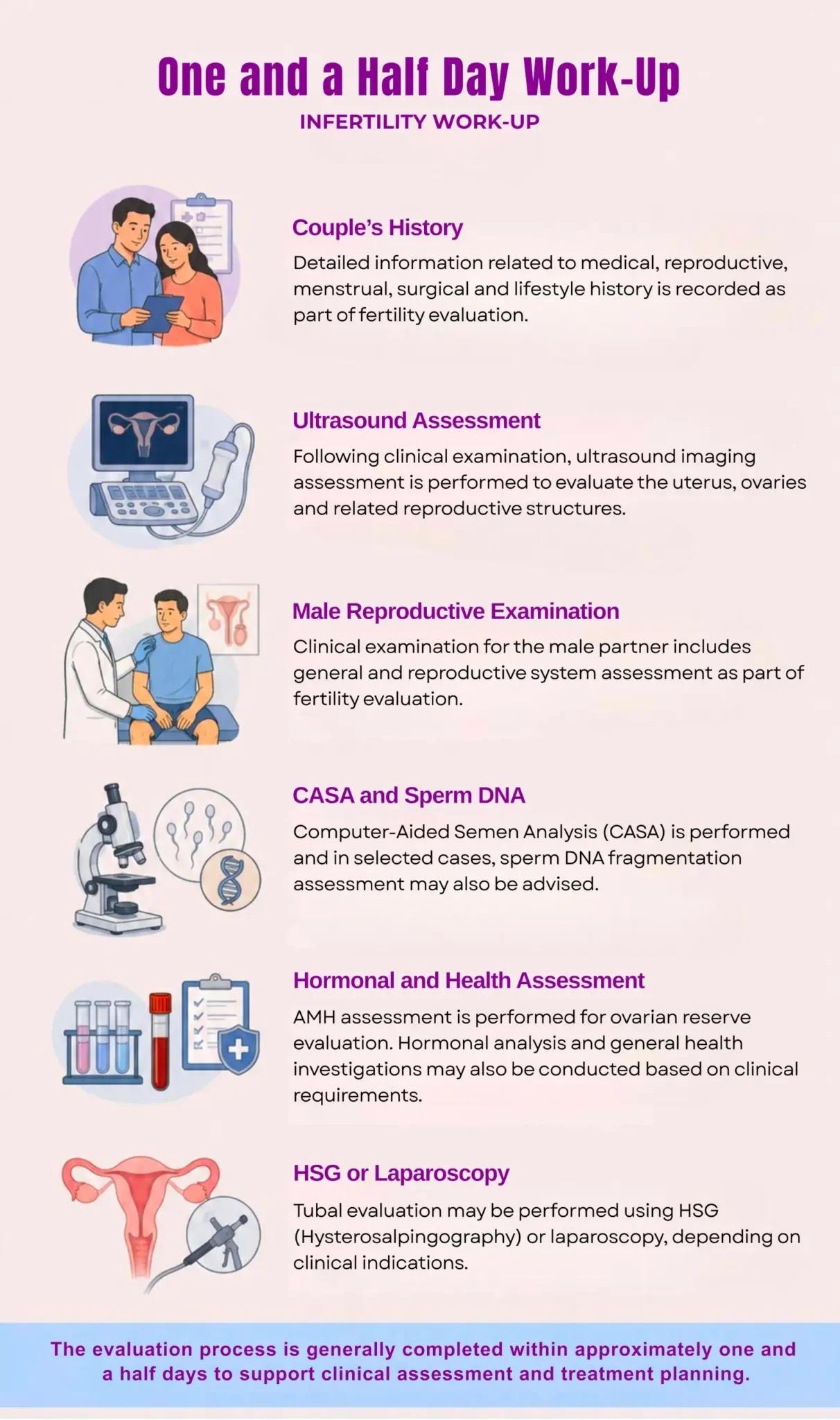
DAY 1 (One Day) – Initial Assessment and Documentation
1. Documentation and Review
Documentation: The initial visit includes patient identification, written consent, and allocation of a unique identification number for Electronic Health Records (EHRs).
Review: A comprehensive review of previous medical records, prior treatments and relevant reproductive, menstrual, medical, surgical and lifestyle history is conducted before proceeding with further evaluation.
2. Couple Evaluation
A detailed medical and reproductive history is recorded using structured clinical documentation methods.
A systematic approach is employed for Subjective, Objective, Assessment and Plan (SOAP) documentation.
3. Assessment of Uterus and Ovaries
Ultrasound imaging assessment is performed for evaluation of the uterus, ovaries and related reproductive structures.
In selected cases, advanced reproductive imaging techniques including transvaginal ultrasound and follicular imaging assessment may be utilized as part of fertility evaluation.
4. Assessment of Male Factor
Computer-Aided Semen Analysis (CASA) is used for preliminary semen analysis.
DNA fragmentation assessment may be performed in selected cases.
Scrotal ultrasound evaluation may also be advised where clinically indicated.
5. Endocrine Assessment
Endocrine conditions may influence reproductive health and fertility evaluation. Thyroid and prolactin hormone levels may be assessed in women.
In selected cases, Anti-Müllerian Hormone (AMH) and pituitary hormone evaluation may also be advised.
6. Tubal Factor Assessment (if necessary)
Fallopian tube evaluation may be performed using Hysterosalpingography (HSG) or laparoscopy depending on clinical indications.
DAY 2 (Half Day) – Report Review and Consultation
1. Submission of Reports
Some investigations are completed on Day 1, while selected fasting blood tests may be conducted on Day 2.
Investigation reports are reviewed on Day 2 to support clinical assessment and treatment planning.
2. Diagnosis and Treatment Options
Male and female reproductive factors are discussed separately where appropriate.
Treatment options expected clinical considerations, possible outcomes and limitations are explained based on evaluation findings.
3. Protocol Explanation
A detailed discussion regarding diagnosis, treatment options, procedures, costs, duration of stay, possible risks and clinical considerations is documented and explained to the couple.
4. Couple’s Decision
The couple’s decision remains central to treatment planning.
They are encouraged to review the information provided and consider appropriate treatment options based on clinical advice and individual circumstances.