
Consanguineous Marriage and Genetic Risk: What Couples Should Know Before Pregnancy
Marriage between relatives is a longstanding cultural and family tradition in several communities. Conversations about its medical implications should therefore remain respectful, factual and free from judgement.
A consanguineous marriage does not mean that a couple will necessarily have a child with a genetic condition. However, biological relatives are more likely than unrelated partners to have inherited the same disease-causing gene variant from a shared ancestor. This can increase the possibility of certain inherited conditions in their children. In clinical genetics, the term “consanguineous couple” commonly refers to partners who are related as second cousins or closer.
Preconception genetic counselling and appropriately selected carrier screening can help couples understand these possibilities before pregnancy and make informed, personal decisions.
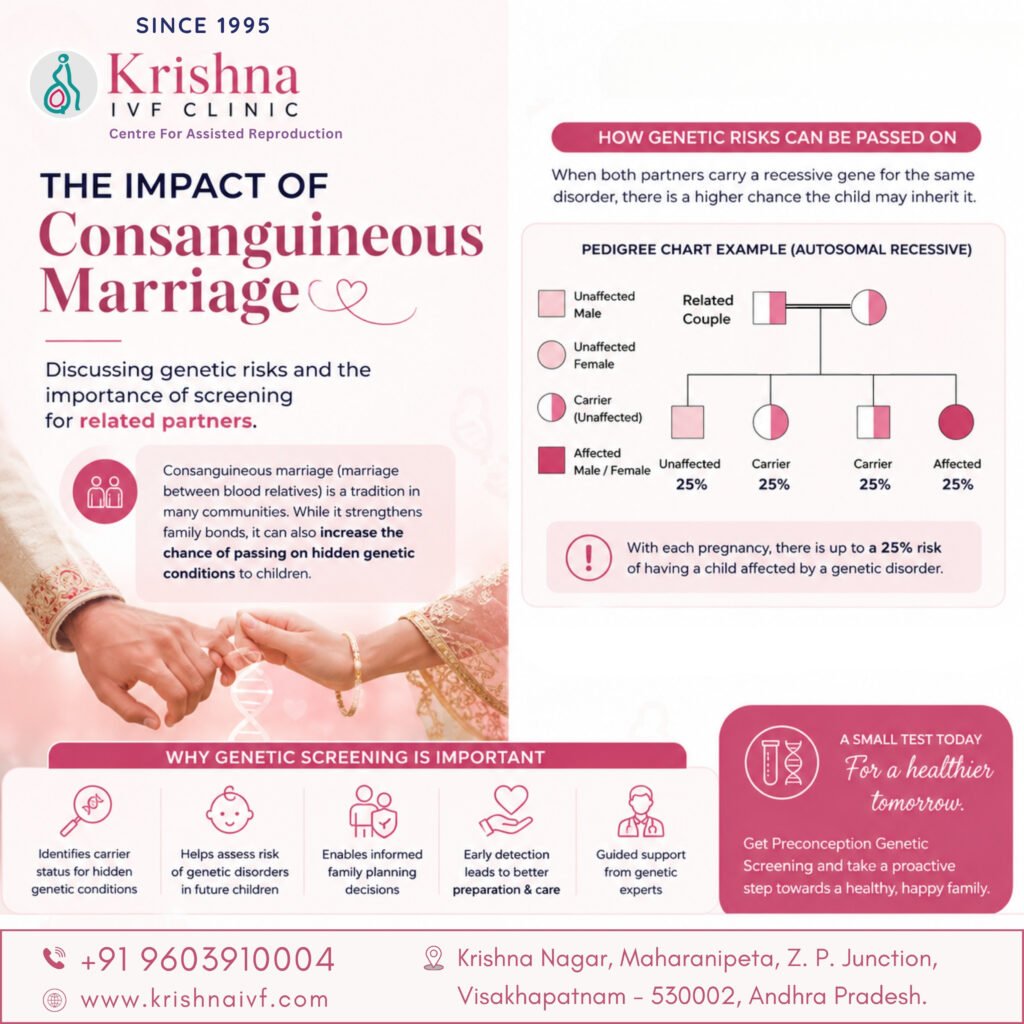
How are recessive genetic conditions inherited?
Every person carries genetic variations. Most do not cause illness, and many people who carry a variant associated with a recessive disorder have no symptoms.
An autosomal recessive condition generally develops when a child inherits two disease-causing copies of the same gene—one from each biological parent. A person who has only one disease-causing copy is usually described as a carrier. Carriers are often healthy and may be unaware of their carrier status unless they undergo testing or an inherited condition is identified in the family.
Related partners may be more likely to carry the same recessive variant because some of their genetic material comes from common ancestors.
Understanding the 25% inheritance pattern
When both partners are confirmed carriers of the same autosomal recessive condition, the expected possibilities for each pregnancy are:
| Possible outcome | Chance in each pregnancy |
|---|---|
| Child inherits both altered copies and is affected | 25% |
| Child inherits one altered copy and is an unaffected carrier | 50% |
| Child inherits neither altered copy and is not a carrier | 25% |
These probabilities apply separately to every pregnancy. Having one affected or unaffected child does not change the genetic probability for the next pregnancy.
An important clarification
The 25% figure is not the risk for every consanguineous couple. It applies only when both partners carry a disease-causing variant in the same gene for a classic autosomal recessive condition.
If the couple’s carrier status is unknown, their individual risk cannot be determined from their relationship alone. The degree of relationship, family history, ancestry, previous genetic diagnoses and test findings all need to be considered.
Why can preconception genetic counselling be helpful?
Preconception counselling provides time to review relevant information before pregnancy. Professional guidance may help a couple:
- Understand how closely they are biologically related.
- Prepare a detailed family health history.
- Identify any diagnosed or suspected inherited conditions in the family.
- Determine whether targeted testing or broader carrier screening may be appropriate.
- Understand the benefits and limitations of available tests.
- Discuss reproductive and prenatal diagnostic options when a significant risk is identified.
Carrier screening can be performed before or during pregnancy, although professional guidance generally supports offering it before pregnancy when possible. This provides more time for counselling, confirmatory testing and informed decision-making. Screening remains voluntary and should be undertaken only after appropriate discussion and consent.
Who should consider an individual genetic risk assessment?
An assessment may be particularly relevant when:
- The partners are biologically related.
- Either partner is already known to carry an inherited condition.
- A genetic disorder has been diagnosed in either family.
- The couple previously had a child or pregnancy affected by a suspected genetic condition.
- There is a family history of congenital differences, developmental conditions, unexplained early childhood deaths or recurrent occurrence of the same medical condition.
- A laboratory report or prior medical consultation has raised a possible genetic concern.
The presence of one of these factors does not establish that a future child will be affected. It indicates that an individualised assessment may provide useful information.
What happens during genetic risk assessment?
1. Detailed family-history reviewThe consultation generally begins with the personal and family medical history of both partners. Where possible, information covering several generations may be collected.
Medical records or previous genetic reports can be especially valuable. Terms such as “weakness,” “developmental delay,” “blood disorder” or “childhood illness” may refer to many different conditions and should not be interpreted without suitable records and clinical evaluation.
2. Targeted genetic testingWhen a specific disease-causing variant is already known in the family, testing can often focus on that particular gene or variant. Testing an affected family member first may sometimes provide more informative results than beginning with an unaffected relative.
3. Carrier screeningCarrier screening examines selected genes associated with inherited disorders. Depending on the clinical situation, testing may be targeted to a specific condition or may use a broader panel.
When one partner is identified as a carrier, testing the other biological partner may be recommended to determine whether the couple carries variants associated with the same recessive condition.
The appropriate test is not identical for every couple. It should be selected after considering family history, existing reports, ancestry, clinical findings and laboratory capabilities.
What if both partners are carriers?
When both partners carry disease-causing variants associated with the same autosomal recessive condition, a clinical geneticist or qualified genetic counsellor can explain:
- The expected inheritance pattern.
- The possible severity and variability of the condition.
- Whether additional or confirmatory testing is required.
- The limitations of the available evidence.
- Options before or during pregnancy.
- The medical, practical and emotional implications of each option.
Depending on the diagnosed condition and the couple’s circumstances, discussions may include natural conception with condition-specific prenatal diagnostic testing, IVF with preimplantation genetic testing for monogenic conditions, or other family-building pathways.
These discussions should be non-directive. The role of counselling is to provide accurate information and support the couple’s informed decision—not to make the decision for them.
What is PGT-M?
Preimplantation genetic testing for monogenic conditions, or PGT-M, is a specialised test used with IVF when a particular single-gene condition has been identified in a family. Embryos created through IVF are tested for the specific familial condition before decisions about embryo transfer are made.
PGT-M is not a universal test for every possible genetic or medical condition. It usually requires condition-specific planning and coordination between reproductive medicine, genetics and specialised laboratory teams.
It is also important to understand that PGT-M does not guarantee:
- That embryos suitable for testing will be available.
- That an embryo without the familial condition will be available for transfer.
- Embryo implantation.
- Pregnancy.
- Live birth.
- The absence of every genetic, developmental or medical condition.
Further prenatal screening or diagnostic evaluation may still be discussed based on the clinical circumstances and professional guidance.
Does a negative carrier-screening result remove all genetic risk?
No genetic screening panel can evaluate every gene variant or every possible inherited condition.
A negative result generally reduces the likelihood that the person carries one of the variants covered by that test, but it does not reduce the possibility to zero. This remaining possibility is called residual risk. Test results can also occasionally be uncertain or uninformative and may require evaluation of other family members or additional testing.
Results should therefore be interpreted in the context of the couple’s family history and the scope and limitations of the laboratory test.
Screening and diagnosis are not the same
A screening test estimates whether a person or pregnancy may have an increased likelihood of a particular condition.
A diagnostic test is designed to determine, with greater certainty, whether a specific genetic condition is present. A positive screening result may therefore require counselling and additional testing before clinical decisions are made.
A respectful, informed approach
The purpose of genetic counselling is not to create fear or to stigmatise family traditions. It is to help couples understand information that may be relevant to their reproductive health.
Many related couples have healthy children. At the same time, identifying a shared carrier status before pregnancy may allow a couple to understand a specific genetic possibility earlier, consider appropriate testing and make decisions consistent with their medical needs and personal values.
Key message
For partners who are biologically related, a small test cannot predict every aspect of a future child’s health. However, a structured preconception assessment can clarify known risks, identify carrier status for selected conditions and support informed family-planning decisions.
Couples with consanguinity, a known inherited condition or a concerning family history may seek an individualised evaluation from a qualified fertility specialist, clinical geneticist or genetic counsellor.
Frequently asked questions
Does consanguineous marriage mean that a child will have a genetic disorder?
No. Biological relatedness does not mean that a child will necessarily be affected. It may increase the possibility that both partners carry the same recessive variant, which is why individual risk assessment can be useful.
Is the risk always 25%?
No. The 25% probability applies only when both biological parents are carriers of disease-causing variants for the same autosomal recessive condition. It applies independently to each pregnancy.
Can healthy people carry genetic conditions?
Yes. Carriers of many autosomal recessive conditions have no obvious symptoms and may learn about their status only through screening or family testing.
When is carrier screening best performed?
Carrier screening may be performed before or during pregnancy. When possible, preconception screening allows more time to review results and discuss available options.Is IVF required when both partners are carriers?
Not necessarily. IVF with PGT-M may be one option for certain identified single-gene conditions, but it is not the only possible pathway. Appropriate options depend on the condition, test findings, medical circumstances and the couple’s preferences.
Can one genetic test screen for every inherited disorder?
No. Genetic tests differ in the genes and variants they examine. A negative result reduces risk for the conditions included in that test but does not exclude every possible genetic condition.
Medical disclaimer
This article is intended solely for general educational and informational purposes. It does not provide individual genetic risk assessment, diagnosis or personalised treatment advice. Genetic risks and suitable tests vary according to the degree of biological relationship, family history, ancestry, clinical findings and laboratory results. Individuals should seek evaluation from a qualified medical professional or genetics specialist before making healthcare or reproductive decisions.