
Diabetes Mellitus, Sperm DNA Damage and IVF Outcomes – Krishna IVF Evidence
Diabetes mellitus is a major systemic disease, and male reproductive health is one of its emerging casualties. Over the last two decades, Krishna IVF Clinic has contributed original research showing how type 2 diabetes in men affects sperm DNA integrity, embryo development and pregnancy outcomes during ICSI.
Krishna IVF study: what we investigated
Between 2008 and 2010, we prospectively evaluated men with type 2 diabetes undergoing ICSI at Krishna IVF and compared them with non-diabetic men treated in the same period. All couples had carefully selected female partners (age ≤ 40 years, BMI < 30 kg/m², no major female factor pathology) so that the male factor and diabetes status could be meaningfully assessed
We used:
• Computer aided semen analysis (CASA) for detailed motility and morphology.
• Sperm chromatin dispersion (SCD) assay for nuclear DNA fragmentation.
• Uniform ovarian stimulation and ICSI protocols with culture to blastocyst stage for both groups.
Key findings from Krishna IVF Clinic
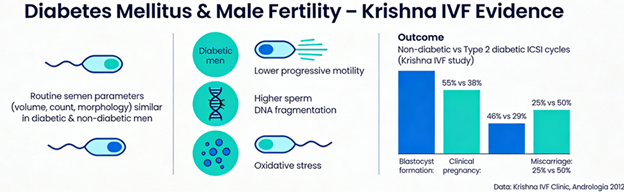
Our data showed that routine semen parameters alone were misleading. Semen volume, sperm count and normal morphology were similar in diabetic and non diabetic men. The real differences emerged when we looked at progressive motility and DNA fragmentation:
• Type A (rapid progressive) motility was significantly lower in diabetic men (14.64 ± 9.60%) vs controls (17.99 ± 11.51%, P < 0.02
• Mean sperm DNA fragmentation was almost doubled in the diabetic group (37.05 ± 12.68%) vs non diabetic group (21.03 ± 10.13%, P < 0.001
When these sperm were used for ICSI, fertilisation rates were comparable between groups (77.82% vs 81.03%), but the downstream reproductive outcomes were clearly affected. In men with type 2 diabetes, we observed:
• Lower blastocyst formation rate (38.13% vs 55.46%, P < 0.001
• Lower clinical pregnancy rate (28.57% vs 46.34%, P < 0.001
• Nearly double miscarriage rate after clinical pregnancy (50.0% vs 24.56%, P < 0.001).
These findings strongly support the concept that diabetes related oxidative stress causes sperm DNA and mitochondrial damage, which may not prevent fertilisation but can compromise embryo development and post implantation survival.
Why these results matter for couples with diabetes
For many diabetic men, a “normal” semen report can create false reassurance. Our work shows that even with acceptable counts and morphology, hidden DNA damage can:
• Slow embryo progression from day 3 to blastocyst.
• Reduce the chance of achieving an ongoing pregnancy.
• Increase the risk of early miscarriage, even with ICSI and good ovarian response
This has several practical implications:
• Diabetic men with infertility or recurrent pregnancy loss should be evaluated for sperm DNA fragmentation, not just routine semen analysis.
• Optimising glycaemic control and reducing oxidative stress are essential pre treatment strategies.
• In ART planning, couples should be counselled about possible lower blastocyst and pregnancy rates and higher miscarriage risk, especially when HbA1c is poorly controlled
Krishna IVF approach today
Building on this research and subsequent global evidence, our current protocol for men with diabetes includes:
• Comprehensive andrology evaluation with CASA and selected sperm DNA fragmentation testing.
• Coordination with diabetologists to improve HbA1c and metabolic status before ART.
• Antioxidant and lifestyle strategies to reduce oxidative sperm damage, tailored to the individual.
• Careful embryo culture and transfer policies, with counselling on blastocyst formation, pregnancy and miscarriage probabilities in the context of diabetes
Our goal is to convert research into personalised clinical care so that couples with diabetes are informed, prepared and offered the safest, most effective path to parenthood.
If you or your partner has diabetes and you are planning a pregnancy, you can schedule a consultation at Krishna IVF Clinic, Visakhapatnam, or learn more at www.krishnaivf.com.