
Freezing Time: The Visakhapatnam Breakthrough That Changed IVF Worldwide
Author: Dr. G.A. Rama Raju, Director, Krishna IVF Clinic
For years, one of the most heartbreaking challenges in Assisted Reproductive Technology (ART) was finding a safe way to freeze human embryos. Today, flash-freezing is the gold standard, but the journey to get here was complex.
At Krishna IVF Clinic in Visakhapatnam, we are incredibly proud of the role our team played in solving this global clinical challenge. In 2005, our researchers developed a modified protocol that not only revolutionized embryo survival rates but fundamentally paved the way for safer, healthier pregnancies worldwide.
The Historical Challenge: The “Antifreeze” Dilemma
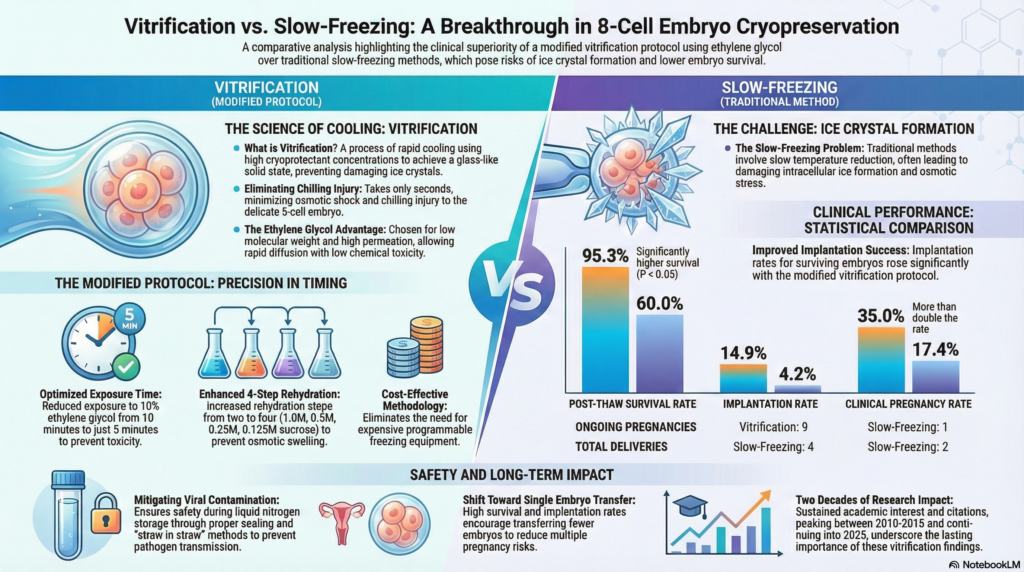
Historically, clinics relied on a method called “slow-freezing.” The problem with slow-freezing was the high risk of ice crystal formation. Imagine freezing a water balloon: as the water turns to ice, it expands and forms sharp crystals that can puncture and destroy the balloon. Because of this cellular damage, only about 60% of embryos survived the thawing process. For families putting all their hopes into these embryos, that number simply wasn’t good enough.
To prevent ice crystals, the scientific community explored vitrification—a flash-freezing technique that drops temperatures so incredibly fast that the liquid inside the cell turns into a solid, glass-like state without ever forming ice.
However, early vitrification had a major flaw. To flash-freeze a cell safely, it must be soaked in cryoprotectants, which act like a biological antifreeze. Unfortunately, the chemicals used at the time were highly toxic if the embryo was exposed to them for too long. Doctors were stuck between two destructive forces: mechanical damage from ice during slow-freezing, or chemical damage from toxicity during fast-freezing.
The 2005 Vizag Breakthrough
Our team at Krishna IVF knew we had to find a way to thread this needle. We conducted a prospective study to completely rethink the vitrification process.
We focused on a specific cryoprotectant called Ethylene Glycol. Because its molecules are tiny, it can diffuse into the embryo to protect it and leave very rapidly, causing far less toxicity. We developed a highly optimized, modified recipe to protect these precious embryos:
• Step One: A gentle, 5-minute equilibration in a mild 10% Ethylene Glycol bath at body temperature (37∘C).
• Step Two: A super-fast, precisely 30-second flash exposure in a stronger solution.
• Step Three: The embryos were carefully loaded onto a custom-made nylon loop (designed right here in our Biomechanical Department) and plunged directly into liquid nitrogen.
• Step Four: To wake the embryos up, we designed a gentle, 4-step thawing process using decreasing levels of sucrose. This prevented water from rushing back into the cells too quickly, avoiding osmotic swelling and degeneration.
A Massive Win for Families
When we evaluated the results, the data was astounding.
Compared to the old slow-freezing survival rate of 60.0%, our modified protocol achieved a massive 95.3% post-thaw survival rate. Even better, our clinical pregnancy rates essentially doubled, jumping from 17.4% to an amazing 35.0%.
Beyond the statistics, this breakthrough had a profound human impact. Because old freezing methods were unreliable, clinics often transferred multiple embryos into a mother just to guarantee a single successful pregnancy, leading to high-risk twins and triplets. Because our vitrification protocol kept embryos so incredibly healthy, it gave ethics committees and doctors the confidence to advocate for transferring fewer embryos. It was a critical enabler for the global shift toward Single Embryo Transfers (SET).
Global Scientific Response
When we published these findings, the response from the global scientific community was truly humbling. Our modified exposure times and the 4-step rehydration process became a foundational blueprint, serving as a reference standard for clinics worldwide.
It was a simple, inexpensive change we made right here in Vizag, but it helped establish flash-freezing as the undeniable procedure of choice for human embryo cryopreservation across the globe.
At Krishna IVF, we remain dedicated to advancing the science of reproductive medicine, always with the goal of bringing safer, more successful outcomes to the families we serve.