
Karyotyping in Fertility Care: Why Chromosome Analysis Matters in IVF
Director, Krishna IVF Clinic, Visakhapatnam
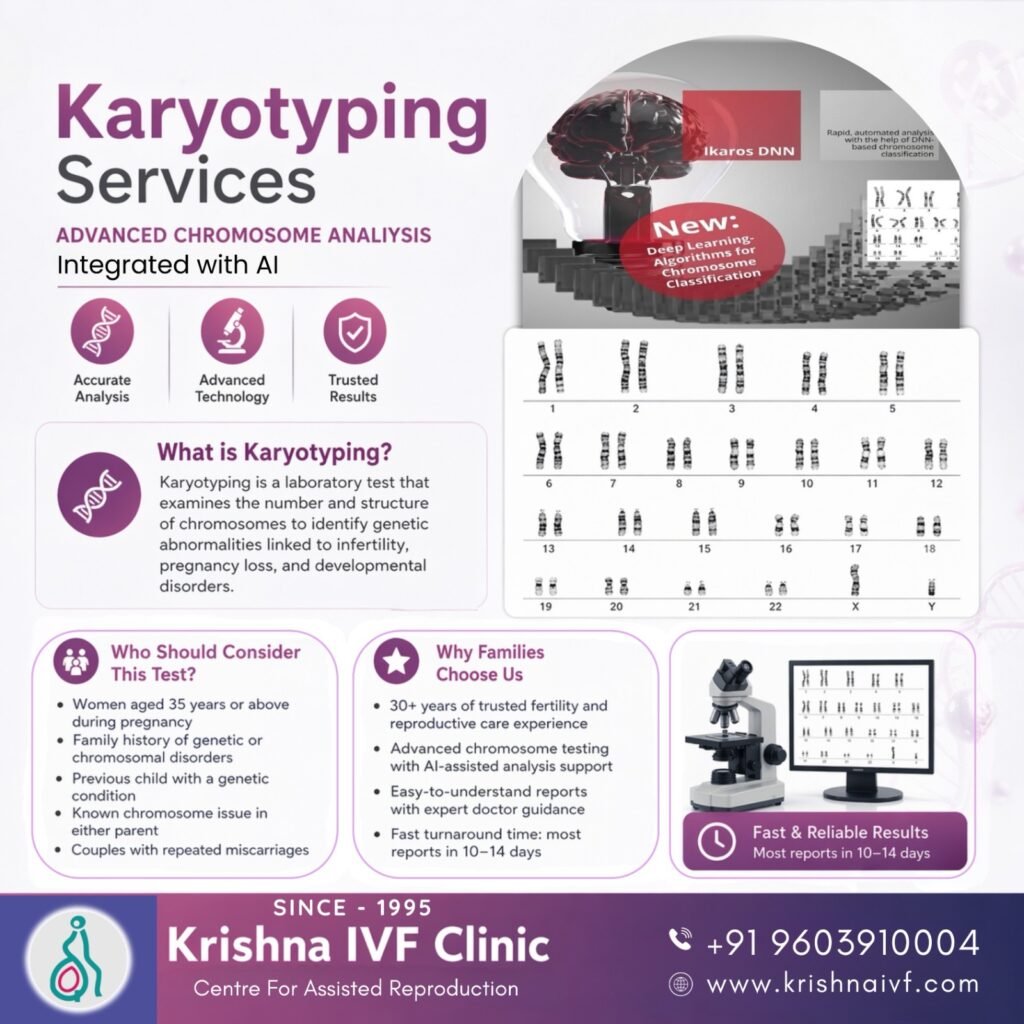
Introduction: The Genetic Dimension of Infertility
Infertility is not always a hormonal or anatomical issue. In a significant subset of couples—especially those with recurrent pregnancy loss, implantation failure, or unexplained infertility—the underlying cause may lie at the chromosomal level.
At Krishna IVF Clinic, we integrate advanced karyotyping with AI-assisted analysis to provide deeper insights into reproductive challenges and guide personalized treatment strategies.
What is Karyotyping?
Karyotyping is a laboratory technique used to:
- Analyze the number and structure of chromosomes
- Detect numerical abnormalities (e.g., trisomy, monosomy)
- Identify structural defects (translocations, inversions, deletions)
Humans typically have 46 chromosomes (23 pairs). Even subtle alterations can significantly impact: - Fertility potential
- Embryo viability
- Risk of miscarriage
- Offspring health
Why Karyotyping is Important in IVF Practice
1. Recurrent Pregnancy Loss (RPL)
Chromosomal abnormalities are identified in 2–5% of couples with RPL
Balanced translocations in parents may lead to unbalanced embryos
➡️ Clinical implication: Helps decide PGT-SR (Preimplantation Genetic Testing for Structural Rearrangements)
2. Repeated IVF Failure
Implantation failure may be linked to embryonic aneuploidy or parental chromosomal defects
Karyotyping allows us to avoid repeated unsuccessful cycles
3. Male Factor Infertility
Conditions like azoospermia or severe oligozoospermia are associated with:
Klinefelter syndrome (47,XXY)
Structural chromosomal abnormalities
➡️ Guides decisions on ICSI, TESE, or donor options
4. Advanced Maternal Age
Increased risk of aneuploid embryos
Karyotyping complements PGT-A strategies
5. Family History of Genetic Disorders
Helps identify heritable chromosomal risks
Enables preventive reproductive planning
AI-Integrated Karyotyping: The Next Frontier
At Krishna IVF Clinic, we are advancing beyond conventional cytogenetics by integrating deep learning-based chromosome classification systems.Advantages of AI-assisted Karyotyping:
● Faster analysis with reduced turnaround time (10–14 days)● Improved detection accuracy
● Standardized reporting (reducing observer variability)
● Scalable for high-throughput clinical practice This aligns with our ongoing work in AI-driven reproductive imaging and genomics, including deep learning applications in ultrasound and embryo assessment.
Clinical Workflow at Krishna IVF
1. Patient Selection● RPL, failed IVF, male factor, genetic history
2. Sample Collection
● Peripheral blood lymphocytes
3. Chromosome Analysis
● High-resolution karyotyping ± AI-assisted classification
4. Genetic Counseling
● Interpretation of results
● Reproductive options explained
5. Treatment Integration
● IVF with PGT
● Donor gametes (if indicated)
● Personalized stimulation protocols
How Karyotyping Influences Treatment Decisions
| Finding | Clinical Impact | Recommended Approach |
|---|---|---|
| Balanced translocation | Risk of abnormal embryos | IVF + PGT-SR |
| Aneuploidy | Implantation failure/miscarriage | IVF + PGT-A |
| Normal karyotype | Explore other causes | Endocrine/immune workup |
| Male chromosomal abnormality | Severe sperm dysfunction | ICSI ± genetic counseling |
Patient Perspective: Why This Test Matters
For patients, karyotyping provides:● Clarity after repeated failures
● Reduced emotional burden through targeted treatment
● Higher success rates with appropriate interventions
● Informed reproductive choices
Limitations and Considerations
● Does not detect single gene mutations (requires advanced genetic testing)● May miss low-level mosaicism
● Needs integration with clinical, hormonal, and embryological data
Future Directions in Genetic Fertility Care
● Integration of non-invasive embryo testing● AI-driven genomic prediction models
● Combined imaging + genetics platforms
● Personalized IVF protocols based on genotype-phenotype correlation
Conclusion
Karyotyping is no longer just a diagnostic test—it is a decision-making tool in modern reproductive medicine.
By combining genetics, artificial intelligence, and clinical expertise, we can move toward precision fertility care, improving outcomes while minimizing emotional and financial burden for couples.
At Krishna IVF Clinic, our goal is not just to achieve pregnancy—but to ensure healthy, successful parenthood.
FAQs
1. Is karyotyping necessary for all IVF patients?
No. It is recommended for selected cases such as recurrent miscarriages or failed IVF cycles.
2. How long does the test take?
Typically 10–14 days, depending on lab processing.
3. Can abnormal results be treated?
While chromosomal abnormalities cannot be corrected, IVF with PGT can help select healthy embryos.